


Dossium is now live. Context that compounds — for your whole team.
Get started at dossium.aiYou have a customer call in an hour. You need to know what happened in the last QBR, whether there are open support tickets, and what their VP said in that Slack thread last month. So you open five tabs and start searching.
This happens constantly. The data exists. But search isn't structured context.
A Twitter thread from Aakarsh Karjal captured it perfectly:
I want a tool that can pull in context from all my tools (email, Slack, meetings, CRM) and give me a complete picture of any customer relationship. Not search. Structured context. Identity-resolved. AI-ready.
Dozens of replies described the same frustration. Dozens more claimed to be building it. But most are starting from scratch - discovering problems like identity resolution and temporal validity as they go. One reply called identity resolution "a nightmare." Others are bolting semantic search onto personal note-taking and calling it customer context. It's not. Personal memory is individual; customer context is organizational. Embeddings are not identity resolution. Notes are not temporal truth.
Here's a simple test: can the system answer "what is true about this customer right now, and how did that change over the last six months?" If the answer requires manual synthesis, it's not customer context.
Drew Bredvick at Vercel made the same observation after building account-focused knowledge bases internally: "No one actually has a batteries-included version yet."
We've spent three years building context infrastructure: multimodal ingestion, identity resolution, entity extraction, temporal modeling. We shipped it as Graphlit, a platform powering vertical AI applications. We built Zine on top of it for personal memory. Now we're taking the next step: from personal to organizational. The request we kept hearing wasn't "give me an API." It was: "give me the product for my team."
So we're building one.
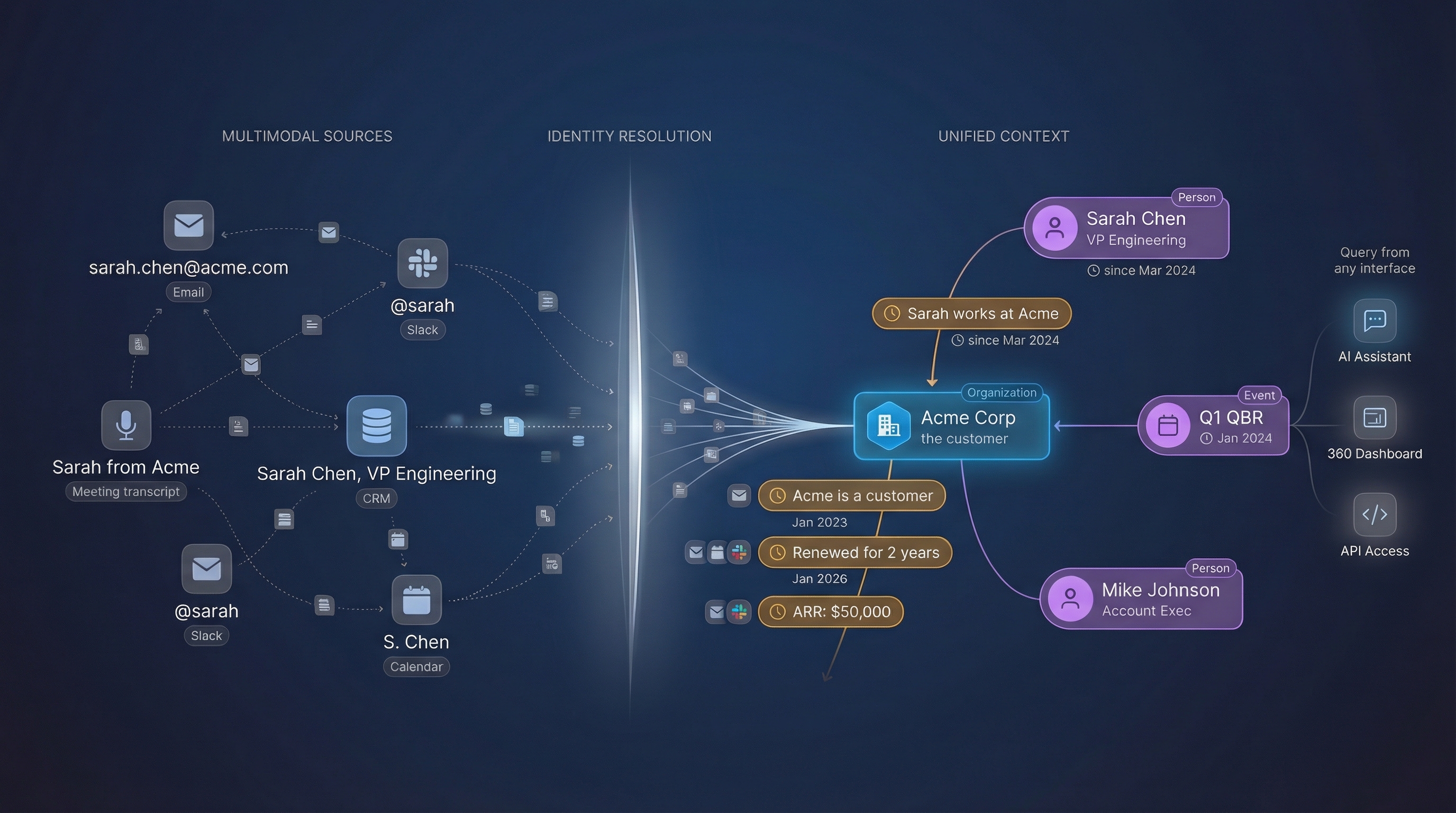
Dossium is a customer context platform. The name comes from an old idea: that when scattered records are finally assembled, reconciled, and made authoritative, what emerges isn't just a file - it's a substance. The material of the dossier. Connect your CRM and communication tools. We unify everything into customer-scoped context: identity-resolved, temporally-aware, queryable by humans and AI agents alike.
The Shape of the Problem
The account executive has a renewal call in an hour. She searches Gmail for "Acme" - thirty results, mostly noise. She tries Slack, but the relevant thread is in a channel she's not in. The CRM shows last activity two months ago: "follow-up call." She pings a colleague who might remember something useful.
The customer success manager is preparing a QBR. He needs to know which features the customer actually uses, what issues they've hit, and what their champion said in that executive briefing last quarter. The data exists across product analytics, Zendesk, and a recorded call somewhere. Assembling it takes half a day.
The support engineer gets escalated a ticket. The customer is frustrated, referencing "the same issue from last month." There's no thread connecting past incidents. She starts from scratch, asking questions the customer already answered.
The CEO asks a simple question in the board meeting: "What's the health of our top ten accounts?" No one can answer confidently without a week of preparation.
Every role. Same problem. The information exists. It's fragmented across tools that don't talk to each other, with no coherent way to ask: "What do we know about this customer?"
Most teams don't want to assemble context. They want to understand their customers.
What We're Building
One place for everything you know about a customer.
Dossium connects to your CRM, email, calendar, Slack, meeting recordings, and documents. Upload anything else - contracts, proposals, research reports. Everything organized around your customers.
Prep for calls in seconds, not minutes. Before a customer call, see the full timeline: recent emails, last meeting notes, open support tickets, what their champion said in Slack last week. No more searching five tools. No more pinging colleagues.
Know what changed since you last checked. Context isn't static. Dossium tracks when things change - contract renewals, stakeholder promotions, new concerns raised. You see what's true now and how it evolved.
Enrich with external signals. Pull in company news, funding announcements, leadership changes. The context that shapes a relationship isn't just internal - it's also what's happening in their world.
Keep using your existing tools. Gmail, Slack, Zoom, Salesforce, HubSpot - nothing changes about how you work. We connect to them, watch for new activity, and weave the fragments into a coherent picture. The connections were always there. Now they're visible.
Let your AI tools see the same context. If you're using AI assistants or copilots, they can query your customer context directly. Ask "what should I know about Acme before my call?" and get a real answer - not search results, but the full picture.
We're not replacing your stack. We're making it useful.
How It Works
CRM as the Spine
For customer context specifically, CRM accounts are the natural organizing principle. The CRM represents "companies I have a business relationship with" - exactly the entities you need context about. Accounts in Salesforce, HubSpot, or Attio become the namespaces that all other data resolves to.
When we ingest an email from sarah@acme.com, we don't just store it as a document. We link it to Acme Corp. When we transcribe a meeting with Acme attendees, it connects to both the company and the people involved. When someone mentions "Acme" in a Slack thread, we resolve that mention to the canonical entity.
Everything flows to the customer. The CRM tells us which companies matter. We fill in everything else.
Identity Resolution
This is where most approaches fall apart. One reply to that Twitter thread called it "an entity resolution nightmare." It's a nightmare if you rely on string matching and heuristics. Solving it takes real investment.
Sarah Chen appears in your data as:
- sarah.chen@acme.com in email
- @sarah in Slack
- "Sarah Chen" in your CRM
- "Sarah from Acme" in a meeting transcript
- "S. Chen" on a calendar invite
These are all the same person. But to a naive system, they're five different text strings with no relationship.
I wrote in the operational context piece that identity resolution is foundational. You can't reason about actors if the same entity appears as fragmented text across tools. Dossium resolves identities automatically, using signals from your CRM, email domains, behavioral patterns, and explicit links to unify fragmented references into canonical people and organizations.
When you look at Acme's context, you see Sarah Chen, not five disconnected mentions scattered across sources.
Facts, Not Just Content
Most knowledge systems stop at documents. They store the email, maybe extract some keywords, and call it done.
We go further. We extract facts, structured assertions with temporal validity:
- "Acme renewed their contract for 2 years" (January 2026)
- "Sarah Chen is VP Engineering at Acme" (since March 2024)
- "Acme is evaluating the enterprise tier" (mentioned in QBR, December 2025)
- "Acme's ARR is $50,000" (from CRM, current)
I wrote about this in Building the Event Clock: the distinction between what's true now and how truth evolved over time. Facts are timestamped, sourced, and linked to entities. This matters because customer relationships evolve. Sarah might have been a Senior Engineer when you first met her, then got promoted. The contract terms changed at renewal. The stakeholder who championed your product might have left the company.
When AI agents query your customer context, they don't just retrieve text chunks. They understand what's true, when it became true, and where that information came from. That's the event clock in action.
Human-Native
For humans, we provide one screen per customer with everything organized.
Timeline: Every interaction in chronological order. Emails, meetings, Slack threads, support tickets, document shares. The full arc of a relationship at a glance.
Content: All documents, recordings, and messages related to this customer. Searchable, filterable, browsable.
People: Everyone involved in the relationship, their contacts and your team members. Who's talked to whom, when, about what.
Facts: The extracted knowledge about this customer. Contract terms, stakeholder roles, product usage, stated needs. The institutional memory that usually lives only in people's heads.
The goal: prep for a call in 30 seconds instead of 10 minutes.
Agent-Native
Here's where the architecture pays off.
A year ago, we would have built a chatbot and called it done. But interfaces change. The chat UI that feels cutting-edge today will feel dated in eighteen months. What won't change is the need for AI systems to access structured context about your customers.
Dossium is designed for humans, with agent access built in. We expose customer context through MCP, through direct API calls, through whatever integration pattern your agents prefer. Agents are compute; context is data. The context layer is the durable asset. The interface is whatever works for you.
Connect Dossium to Claude, Cursor, or your own agents, and they can:
- Retrieve context about any customer
- Search across your customer knowledge base
- Get facts and relationships, not just documents
- Scope queries to specific customers or time ranges
Ask Claude: "What should I know about Acme before my call today?"
Thirty seconds later:
Acme renewed their contract in January for 2 years at $50k ARR. Their VP Engineering, Sarah Chen, mentioned budget concerns in a Slack thread two weeks ago. The last QBR focused on API performance. They were evaluating the enterprise tier. No open support tickets currently.
That's not search results. That's synthesized context from a customer-scoped context graph. The same infrastructure that powers the UI powers agent access. Use whichever interface fits your workflow.
Context Where You Need It
The same context that powers retrieval also powers everything else. Different situations call for different delivery modes:
Ask and get answers. Chat with your customer context directly. "What's the history with Acme?" "What did Sarah say about the pricing in our last call?" "Which accounts mentioned budget concerns this quarter?" Real-time, conversational, grounded in what actually happened.
Generate documents on demand. Need a QBR prep doc? A board summary? A handoff document for a CSM transition? Ask in chat and get a draft grounded in your actual customer context - not hallucinated, not generic, but specific to that relationship. Export to Google Drive or Notion, or download directly.
Get briefings before meetings. Connect your calendar and receive automated prep docs before customer calls. The context you need, surfaced when you need it, without searching.
Set up alerts for what matters. "Tell me when a champion mentions leaving." "Alert me if sentiment turns negative on an enterprise account." "Notify me when a customer hasn't engaged in 30 days." Proactive signals, not just reactive search.
Receive scheduled digests. Weekly summaries of activity across your portfolio. Monday morning briefings on your top accounts. Monthly rollups for leadership. Context delivered on your schedule.
Let your agents pull context. Your sales copilot, your support automation, your internal tools - they can all query customer context through MCP or API. The same unified view, available programmatically wherever your workflows run.
Who This Is For
We've been watching who builds on Graphlit and reading every thread about customer context we can find. A clear pattern emerges: teams where relationships are the work, and context is the bottleneck.
Customer Success teams are the obvious fit. Every renewal, every QBR, every escalation requires context. That context is scattered across inboxes, Slack channels, and institutional memory. CSMs prep for calls by searching five tools and pinging colleagues. Dossium gives teams shared visibility into every customer relationship. Prep in 30 seconds, not 10 minutes.
Founders doing their own CS face a version of this that scales dangerously. In the early days, all the context lives in your head. That's fine with ten customers. But you're hiring. You're handing off relationships. You need to bring new people up to speed without losing what you know. Dossium makes customer context queryable - by you, by your team, and by the AI agents you're starting to rely on.
Account executives and sales teams need the same unified view. What happened in the last call? What's the procurement process? Who's the champion and what do they care about? The answers exist across email, call recordings, and CRM notes. Dossium pulls it together.
The pattern extends beyond traditional customer relationships:
Investors have told us directly: they track portfolio companies and prospects across board meetings, founder updates, news, and market research. The context for any given company scatters across partners' inboxes and note-taking apps. Dossium organizes everything by company.
We expect the same applies to consulting firms running client engagements that span months or years, and agencies managing multiple client relationships simultaneously. If your work is relationships, and your bottleneck is context, this is likely for you too.
Early Access
You won't wait long to see value. Connect CRM. Connect email. Connect Slack. Connect calendar. That's a lot of OAuth prompts - but we've optimized for progressive visibility. Your first customer view starts populating in minutes, and the picture gets richer as more data flows in.
We're looking for design partners to shape this with us.
For existing customer support or transition requests, contact support.
The teams who join early will shape what this becomes.
For more on the underlying architecture, see: The Context Layer AI Agents Actually Need, Building the Event Clock, and Context Graphs: What the Ontology Debate Gets Wrong. For the broader market context, Foundation Capital's Context Graphs: AI's Trillion-Dollar Opportunity is worth reading.